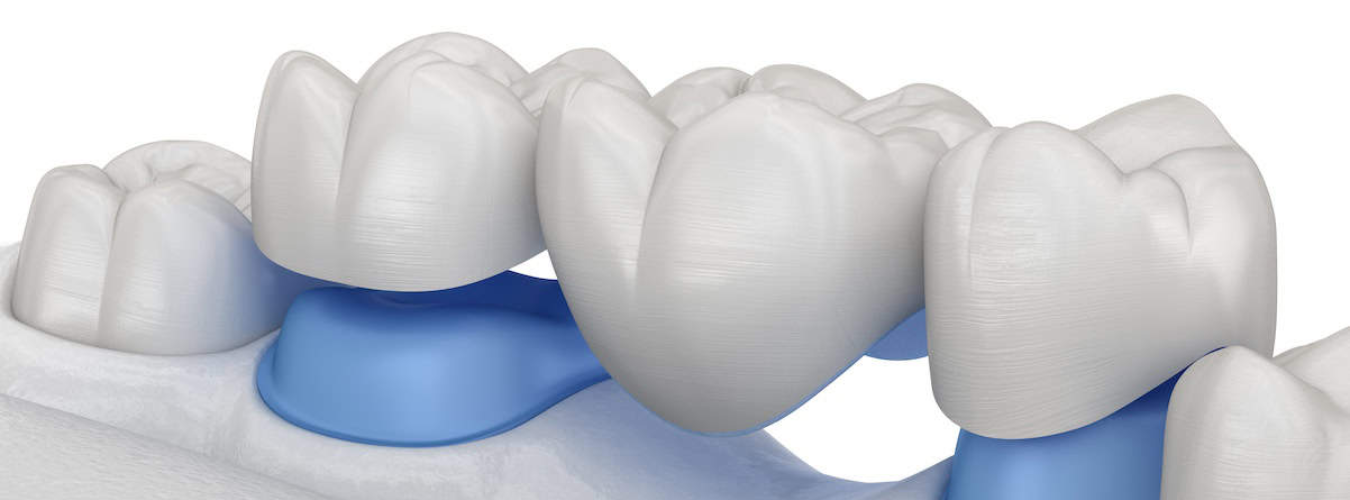
What is bridge?
Bridge is a non removable option for replacement of missing teeth. It is made of two types of components:
I) Abutment - crowned* tooth present in your mouth next to the missing one. It is an anchor for artificial tooth
II) Pontic - artificial tooth replacing the missing one. It is attached to the abutment. That means, that the artificial tooth is supported by the side, not from below.
Each bridge can be made of multiple of each component, depending on individual case.
*Crown is a “cap” covering your natural tooth for protection, aesthetics or as an anchor point in bridges.
There are various materials available for construction of bridges such as: ceramic, porcelain, zirconium, resin, gold, metal etc. Each of the materials has its advantages and dentist will advise you on which would be the best option for you.
THE PROCEDURE:
Bridge procedure includes 2 appointments.
1) On the first appointment it is very likely, that dentist will administer numbing injection, to make you comfortable.
Therefore, we will recommend you to eat before the appointment, as you shouldn’t eat anything or drink any hot liquids, until numbness wears down - that will prevent you from biting on your own tongue or burning your mouth.
Dentist will prepare your abutment tooth/teeth, by shaving a thin layer all around. Then he will take impression of your mouth with silicon - like material. This material will set in your mouth after just a few minutes, giving us a mould of the prepared tooth/teeth and a space of missing tooth/teeth. On this appointment we will choose the shade of the bridge with you. This impression will be send to the dental lab, which will construct the bridge and sent it back to us. In some cases, dentist will place a temporary bridge that will protect you from sensitivity to hot and cold. If you loose your temporary bridge, don’t panic. You can give us a call and we can make a new one, or you can wait until the fit of your permanent bridge, if it doesn’t bother you. After the procedure, you won’t be able to eat for few hours, until the numbness wears off. Later, to prevent loosing temporary bridge, we would advise you to eat on the other side of your mouth.
2) It is unlikely, that you would need numbing injections on the second appointment, but we would still advise you to eat something before, as we will ask you to hold on from eating after the procedure, for about 2 hours, to allow the cement to fully cure and hold the bridge in place.
On the second appointment:
Dentist will check the fit of the bridge on your prepared abutment tooth/teeth then cement (glue) it on. He will check if you are biting equally on both sides with stained paper. That will show him, if your teeth are in contact on both sides, and if any adjustments are needed for better comfort.
After the appointment, please allow the cement to fully cure, before eating.
If the bridge was placed on your front teeth, we will advise you to cut hard foods (such as apple) in pieces, before chewing, instead of biting the piece off. That will prolong the life span of your bridge.
If the bridge was placed on your back teeth, we will advise you to eat hard crunchy foods (such as nuts or crackling) on the other side of your mouth. That will prolong the life span of your bridge.
If your bridge becomes loose at any point, please try to delicately take it out, to prevent chocking hazard. Keep it in safe place, and give us a call to book an appointment ASAP, so the dentist can assess, if he can recement it back on.
Please remember to keep a good oral hygiene.
Some materials of the bridges are “resistant” to X-rays, that means, that on the radiograph, it will appear as a solid white spot, therefore, we will be NOT able to see any decay, in the bridge bearing teeth, on the radiograph, until it reaches the root beneath the bridge. Please remember that majority of the dental decay starts in between the teeth, so flossing is of utmost importance. It is very important to floss underneath all pontics, to prevent gums inflammation’s and boils. To do that, please use Super Floss (which has a hard tip as on shoe laces). Thread it underneath the artificial tooth to clean beneath it. Water flosser is a great aid as well.